Stroke Arm Exercises at Home: 8 Simple Upper Extremity Exercises for Faster Recovery
NeuroRehab Team
Tuesday, September 2nd, 2025
The CDC reports that stroke affects nearly 800,000 Americans yearly, and someone dies from it every four minutes . Affordable equipment and proper arm exercises play a vital role in a stroke patient’s recovery. Neurological damage often affects a stroke survivor’s arm function, which takes a toll on their quality of life .
Outpatient therapy alone doesn’t always provide enough exercise for full recovery . This makes home-based stroke arm exercises absolutely necessary. Shoulder pain affects 18-26% of adults and ranks among the most common musculoskeletal complaints . The good news is that patients who exercise consistently usually improve within 4-6 weeks . This piece outlines simple yet effective upper extremity exercises that stroke patients can do at home with basic equipment to help your loved one recover faster.
How Stroke Affects Arm Function
80% of survivors face arm and hand problems after a stroke [1]. These problems are some of the most challenging parts of getting better. Knowing what changes happen helps create better home-based rehab programs.
Common arm deficits after stroke
Stroke leaves patients with several arm function problems. One-sided weakness or paralysis (called hemiparesis or hemiplegia) shows up as the main problem [2]. On top of that, many survivors can’t feel touch or temperature changes well [3].
Muscle problems are common too. Muscles can get too tight (spasticity) or too loose (hypotonia) [3]. These changes often lead to shoulder pain. Many stroke survivors get this pain from their shoulder joint’s partial separation [4]. Some patients find it hard to coordinate movements, even when their muscles are strong enough [3].
Learned disuse and what it means
Therapists see something they call “learned nonuse” [5]. This happens when patients stop trying to use their affected arm because they got frustrated early in recovery [6]. A bad cycle starts – the arm gets weaker from lack of use.
This creates serious problems. Muscles start to shrink, and the brain changes. Areas that used to control hand function get taken over by parts that handle basic arm movement [6]. Then, without help, patients lose more function. This limits their independence and life quality [7].
Why caregivers play a vital role
Studies show that caregivers are a great way to get better arm recovery results [8]. Research found that caregiver support adds 5-9% to upper limb improvement, beyond what comes from the original condition and exercise amount [8].
Caregivers help break the nonuse cycle. They push patients to keep practicing with their affected arm. They also help position the arm right to stop problems like shoulder separation [4]. A caregiver’s role goes beyond physical help. They cheer patients up when progress slows down and celebrate small wins that mean a lot to recovery [7].
Caregivers become recovery partners by learning about these challenges. They help patients use their affected arm again through regular, focused practice with home-based exercises.
Preparing for Home Arm Exercises
The right preparation makes all the difference in home rehabilitation programs. A proper setup ensures your safety and helps you get the best results from arm exercises after stroke.
Safety tips before starting
Medical clearance is a must before you start arm exercises for stroke patients. Your doctor should review your medical history and examine you to spot any neurological issues or health conditions that might make exercising risky [9]. Most stroke survivors can exercise safely, but risks exist—falls happened to 13-25% of people in some studies [9].
Your doctor should tell you if you need an ECG-monitored exercise test. You can begin a personalized exercise program even if your doctor thinks this test isn’t needed [9]. Stop and call your doctor right away if you feel dizzy, have chest pain, or can’t catch your breath during exercises [10].
How to set up a safe exercise space
A safe environment is vital for stroke rehab exercises. Clear your exercise area of any objects that might cause falls [11]. You need enough space to fit a chair and equipment while moving your arms freely [10].
The safest setup includes:
- Non-slip shoes that support your feet [12]
- Someone nearby to help during exercises [11]
- Hip protectors if you’ve fallen before [10]
- A clear floor without trip hazards [12]
- Good lighting and air flow
When to consult a therapist
Home programs give you flexibility but don’t have specialized rehab equipment [13]. Stay in touch with your healthcare team regularly. Physical therapists create exercises that match your needs [4]. Occupational therapists help you relearn daily tasks with your affected arm [4].
Stop any exercise that causes pain and let your healthcare provider know [4]. Get professional help if you notice odd changes in muscle tone, feel weaker, or have trouble coordinating movements [10].
8 Simple Arm Exercises for Stroke Patients
These exercises need minimal equipment and help stroke survivors get back their arm function with regular practice. Each exercise should challenge you but remain doable. Focus on movement quality rather than repetitions.
1. Shoulder shrug
Take a seat with your feet flat on the floor and keep your back straight. Raise both shoulders toward your ears as high as you can while your head and neck stay relaxed. Count to 5, then lower them [14]. Your stronger arm can help the weaker side if needed, but make sure the affected side works too [15].
2. Shoulder blade squeeze
Sit tall with good posture and pull your shoulder blades back together. Hold this position for 2-3 seconds before you relax [16]. Your elbows should stay close to your sides [15]. This movement helps your posture and builds strength between your shoulder blades.
3. Table towel reach
Put a washcloth or folded towel on a table in front of you. Rest your affected hand on the towel and press down lightly as you reach forward. The towel should slide while you lean forward with a straight elbow [15]. Your stronger hand can help on top at first [17].
4. Seated chest press
Hold a cane or mop handle with both hands at shoulder width. Push it straight ahead, then pull it to your chest as your elbows drop. Press it forward again until your elbows straighten [15]. Your chest, shoulders, and triceps all get stronger with this exercise [18].
5. Bicep curl with cane
Grip a cane with both hands, palms facing up. Start with your arms down and bend your elbows to bring the cane toward your chest. Keep your elbows at your sides [15]. Your stronger arm helps guide the affected one [19].
6. Washcloth squeeze
Spread a washcloth flat on the table. Place your affected hand palm down with fingers spread and gather the cloth into your palm [15]. Make it harder by using a wet washcloth and squeezing out the water [20].
7. Cup flip
Set five cups on a table. Pick up each cup with your affected hand, flip it over, and set it down [15]. This helps you move better in daily tasks by improving coordination and forearm rotation.
8. Card flip
Hold your cards in your stronger hand. Use your affected hand palm down to pick up the top card, turn it over until your palm faces up, and place it on the table [15]. Your fingers become more nimble and coordinated with this exercise [20].
Tracking Progress and Adjusting Routine
Tracking progress helps maximize the benefits of stroke arm exercises. Your recovery depends on consistency and repetition – they are the life-blood of getting better [5].
How to measure improvement
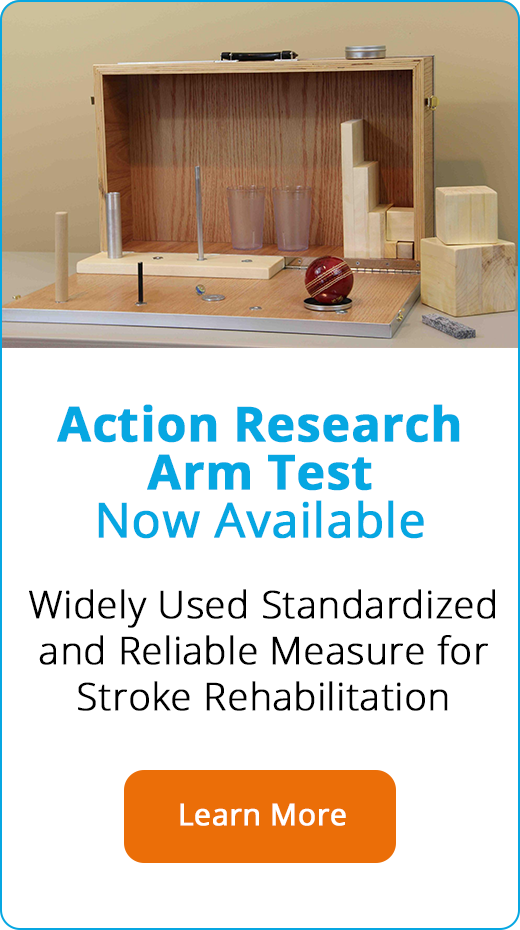
Several verified assessment tools can track your improvements. The Action Research Arm Test (ARAT) measures grasp, grip, pinch, and gross motor movements on a scale of 0-3 [21]. The Fugl-Meyer Assessment reviews selective motion capacity with scores from 0-66 [6]. Simple metrics work too – you can count successful grasps. Some programs aim for at least 1,000 grasps [22].
When to increase difficulty
You should think over making your routine more challenging after steady improvement. Research shows you need at least two hours of weekly training to see measurable effects [6]. Active arm motor training of ≥3 hours per week leads to improvement even during chronic stroke phases [6]. Start with simple movements. Add resistance with small weights or bands once simple movements become easier [23].
Signs to stop or modify an exercise
Pain during any exercise means you should stop right away [5]. It might signal damage to your muscles and joints. You should reduce weight or perform movements within a smaller range of motion if you feel discomfort [5]. Make sure to tell your healthcare provider about any exercise-related pain so they can adjust your treatment plan [4].
Conclusion
Stroke recovery needs patience, persistence, and proper support, especially when helping patients regain arm function. We’ve explored how regular home exercises can substantially boost formal therapy sessions. Our support as caregivers plays a vital role in this recovery. Research shows we contribute 5-9% of upper limb improvement beyond what exercise intensity alone achieves.
These eight exercises just need basic equipment but give substantial benefits when you keep taking them. A consistent routine helps overcome “learned nonuse” and stops muscles from getting weaker. Progress might feel slow sometimes, but each small improvement shows real progress.
Safety should be our main priority. You need medical clearance before starting exercises. A hazard-free environment and knowing when to ask professionals are vital parts of home rehabilitation.
Each person recovers at their own pace. Many patients see improvement within 4-6 weeks of dedicated practice. The secret lies in consistency. At least three hours of active arm training weekly shows measurable improvement, even in chronic stroke phases.
Quality matters more than quantity. Exercises should challenge patients without causing pain or frustration. On top of that, it helps to track progress. This keeps motivation high and gives valuable information to healthcare providers.
Recovery after stroke brings challenges, but meaningful improvement is possible with dedicated practice and proper support. These simple yet effective exercises help our loved ones become more independent. Their quality of life can improve after stroke – one movement at a time.
Key Takeaways
These essential insights will help caregivers support effective arm recovery for stroke survivors through safe, consistent home-based exercises.
• Caregiver involvement is crucial: Research shows caregiver support accounts for 5-9% of upper limb improvement beyond exercise intensity alone, making your role vital in recovery.
• Consistency beats intensity: At least 3 hours of active arm training weekly shows measurable improvement, with most patients seeing progress within 4-6 weeks of dedicated practice.
• Safety first, always: Medical clearance is essential before starting exercises, and any pain during activities requires immediate cessation and professional consultation.
• Simple exercises yield results: Eight basic exercises using minimal equipment (canes, towels, cards) can effectively combat “learned nonuse” and restore arm function at home.
• Quality over quantity matters: Focus on proper form and gradual progression rather than rushing through repetitions – small improvements represent meaningful recovery milestones.
Home-based stroke rehabilitation empowers caregivers to become active partners in recovery, transforming daily practice into meaningful progress toward independence and improved quality of life.
References
[1] – https://www.ahajournals.org/doi/10.1161/STROKEAHA.123.044269
[2] – https://pmc.ncbi.nlm.nih.gov/articles/PMC4844548/
[3] – https://strokefoundation.org.au/what-we-do/for-survivors-and-carers/after-stroke-factsheets/arm-hand-and-shoulder-after-stroke-fact-sheet
[4] – https://www.hopkinsmedicine.org/health/conditions-and-diseases/stroke/arm-care-after-a-stroke
[5] – https://www.neofect.com/blog/the-ultimate-guide-to-stroke-exercises
[6] – https://www.ncbi.nlm.nih.gov/books/NBK585592/
[7] – https://pmc.ncbi.nlm.nih.gov/articles/PMC4819828/
[8] – https://pubmed.ncbi.nlm.nih.gov/20592268/
[9] – https://www.ahajournals.org/doi/10.1161/str.0000000000000022
[10] – https://pmc.ncbi.nlm.nih.gov/articles/PMC3266302/
[11] – https://revitalizephysiocare.com/essential-physiotherapy-exercises-for-stroke-recovery-at-home/
[12] – https://www.linkneuroscience.com/post/exercising-after-a-stroke
[13] – https://www.mayoclinic.org/diseases-conditions/stroke/in-depth/stroke-rehabilitation/art-20045172
[14] – https://www.veteranshealthlibrary.va.gov/3,89939
[15] – https://www.baystatehealth.org/articles/arm-exercises-for-stroke-patients
[16] – https://myhealth.alberta.ca/Health/aftercareinformation/pages/conditions.aspx?hwid=zp4515
[17] – https://www.saebo.com/blogs/clinical-article/reclaim-your-reach-with-shoulder-exercises-for-stroke-recovery?srsltid=AfmBOoptvx2bNJ4hppsCIgmIRaBcFeh6Z9jN_qLAz_ThzMkg0zFzZNdq
[18] – https://www.hingehealth.com/resources/articles/seated-chest-press/
[19] – https://www.facebook.com/livewellwithdrmel/videos/cane-exercises-for-strokethese-are-simple-effective-exercises-for-patients-statu/25264163389866315/
[20] – https://www.baystatehealth.org/articles/hand-exercises-for-stroke-recovery
[21] – https://pmc.ncbi.nlm.nih.gov/articles/PMC4362540/
[22] – https://www.ahajournals.org/doi/10.1161/STROKEAHA.122.038885
[23] – https://www.webmd.com/stroke/features/arm-and-hand-exercises-for-stroke-rehab
Leave a Reply
You must be logged in to post a comment.